
How one little app survived three Apple revolutions
Three times, the foundation you build iPhone software on has fundamentally shifted. When Steve Jobs introduced the first iPhone in 2007, it was a closed system: only Apple could put software on it. The real triumph began in 2008, when Apple opened the platform with the iPhone SDK and the App Store that came with it — an entirely new way to distribute applications worldwide. Then — with Swift — a completely new programming language. And now — with AI — a new way to write code itself. And three times I took the same little app into the new world to find out what had become possible.
The app is CompareMe. The idea is almost embarrassingly simple, and it hasn't changed in seventeen years: put two products face to face and see which one is actually cheaper — even when one is a 14-ounce carton for $3.24 and the other a 12-ounce for $2.95. But the app does more than point at the bargain. It tells you *by how much* you save — or overpay. Because cheaper isn't always better, and people don't want to be told what to buy. They want to know exactly what premium they're paying or what they're really saving. That gives them the freedom to decide for themselves.
I didn't want to theorize about how such an app should work. I wanted to build it, sell it, and prove it: users are willing to actually pay for a useful application with a well-crafted user interface. Build, sell, prove … I've stayed true to that principle, even as I rebuilt everything from the ground up.
2008: the iPhone SDK and the App Store — a brand-new distribution channel
The revolutionary thing Apple introduced in 2008 wasn't just the iPhone SDK. It was the built-in distribution channel: the App Store. At a stroke, a developer anywhere could build apps with the iPhone SDK and sell them through the App Store from day one.
Apple had the right instincts — and a loyal, tight-knit developer community. That community didn't mind that applications could only be developed on a Mac, and only in Objective-C.
New, undiscovered worlds — fascinating. So I dove in. Apple's developer conference WWDC 2008 was the starting point: immersing myself in the introductions and commentary on the freshly released SDKs. Trading solutions with developers around the globe. We all had to figure it out at the same time. Every line of code felt like a step onto a new continent. At the end of December 2008, the first version of CompareMe was finished and submitted to Apple for review. In early January 2009, the moment finally came: CompareMe went live worldwide on the App Store.
Then one day the sales numbers went through the roof. It was surreal. I had no idea why — until a user named Ben wrote in with a question. I answered, and asked, almost in passing, how he'd found CompareMe. His reply, just as casual:
"Btw — I discovered your app via the Apple full-page ad in either the WSJ or NYT a few days ago."
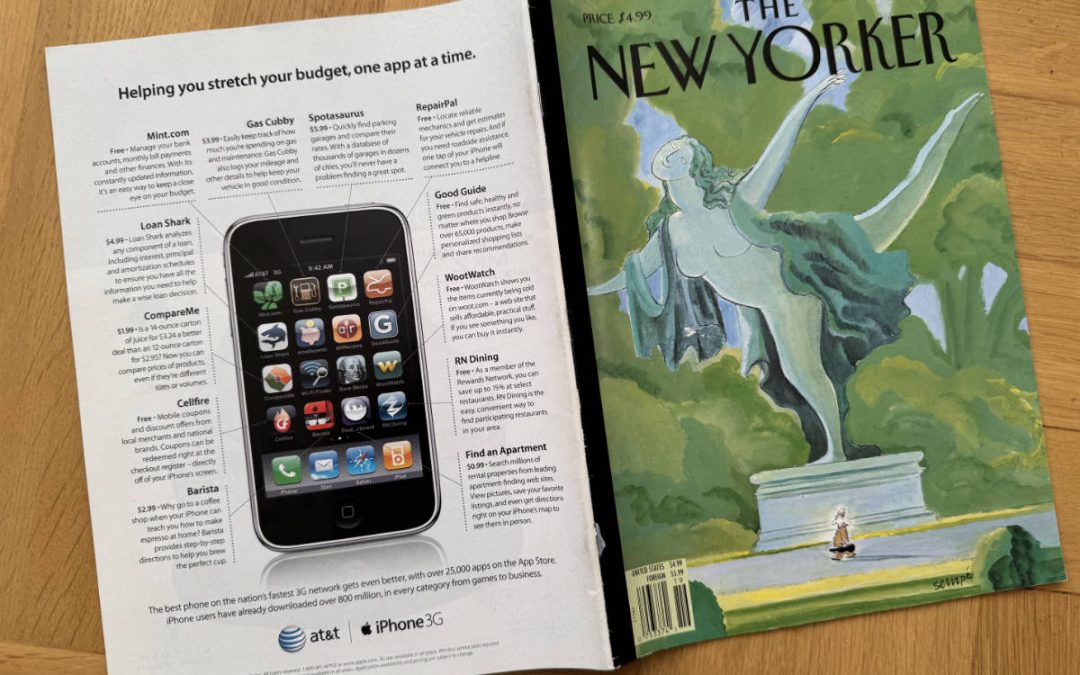
"Helping you stretch your budget, one app at a time" — that was Apple's headline on full-page ads featuring a hand-picked set of budget apps, each in its own slot. CompareMe was one of them, with its own copy and its $1.99 price. It ran on the back page of the Wall Street Journal on April 9, 2009, and on the back cover of The New Yorker on May 4 (see image above). With that ad, Apple made one thing radically clear: smartphones were no longer about phone calls … they were about solving everyday problems with little helpers — apps.
The direct effect was smaller than the legend that later grew around it — a few thousand downloads across those weeks, with my best single day ever landing that Easter Sunday. But this was 2009, when far fewer people carried an iPhone: a few thousand downloads from one ad was a genuine spike, and it set up the app's best year by far.
It wasn't the goldmine people assume. But at the time it was breathtaking — and more than the money, it was proof. Proof that you could actually earn something building for this platform, that the App Store was a real business and not just a hobby with a nice icon. Over the seventeen years since, CompareMe has sold more than 15,000 copies. The ad wasn't the jackpot. It was the spark.
2014: Swift — rebooting the language
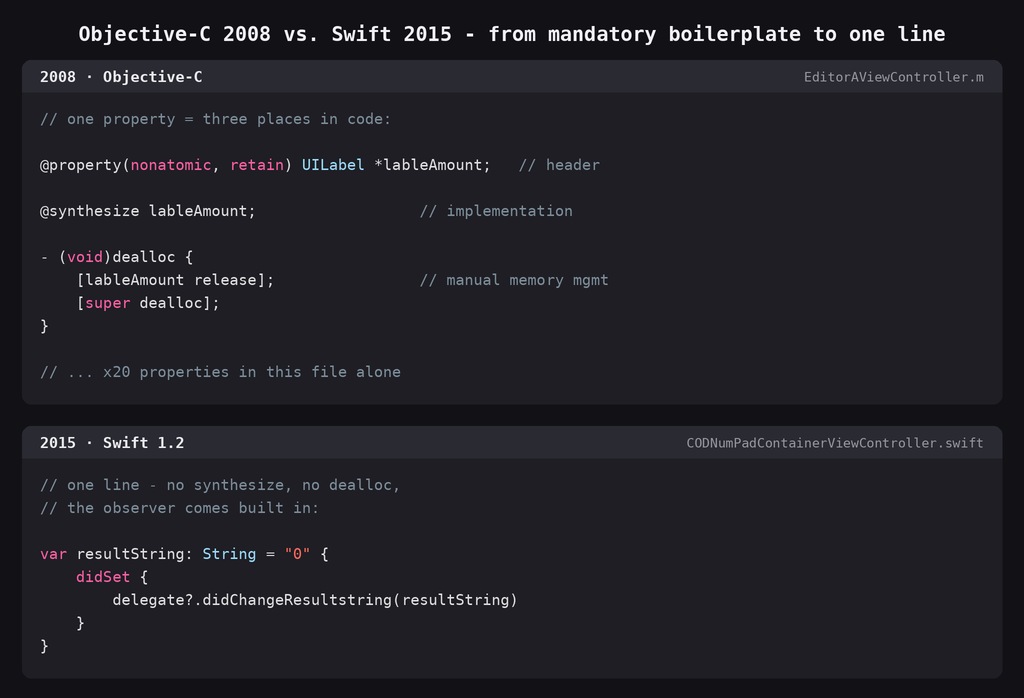
Then, years later, the ground moved again — and this time it really was the foundation. At WWDC 2014 I watched Craig Federighi lift the veil on Swift: a brand-new language, built from the ground up. Decades of lessons from Objective-C had flowed into it. Fascinating possibilities — less exciting for iPhone users, all the more exciting for us nerds.
I was thrilled all over again. There's a particular joy in reading the first specifications and guidelines the moment Apple's engineers finish them — learning a new programming language together with an entire developer community. Starting from zero, together. Pure pioneer spirit. The exchange happened in blog posts, in conference hallways, and on Twitter 😉
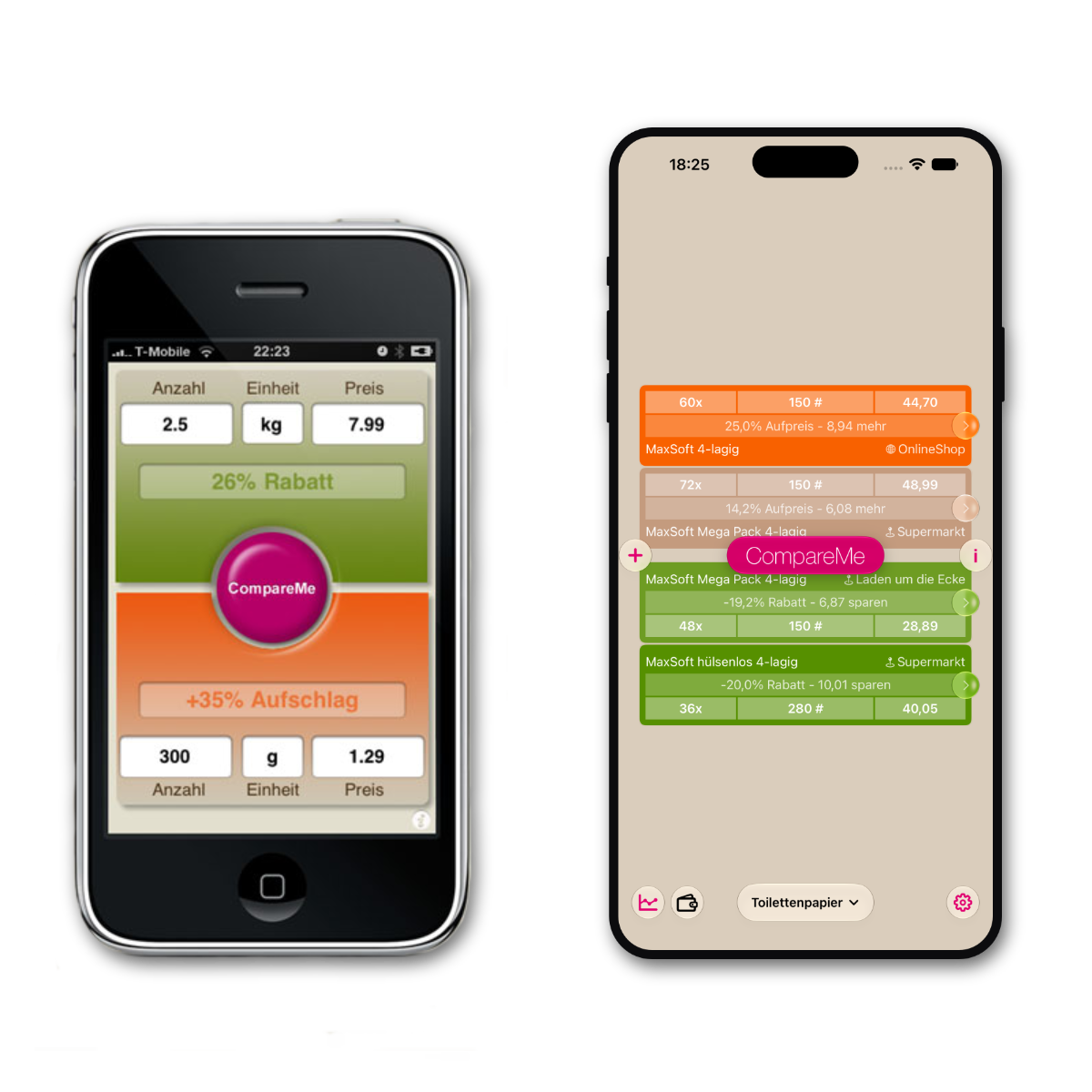
And CompareMe was the perfect candidate for the radical step: not patch it, but rewrite it completely in Swift. New language, new SDK, same users, same needs.
2026: AI — coding with an assistant
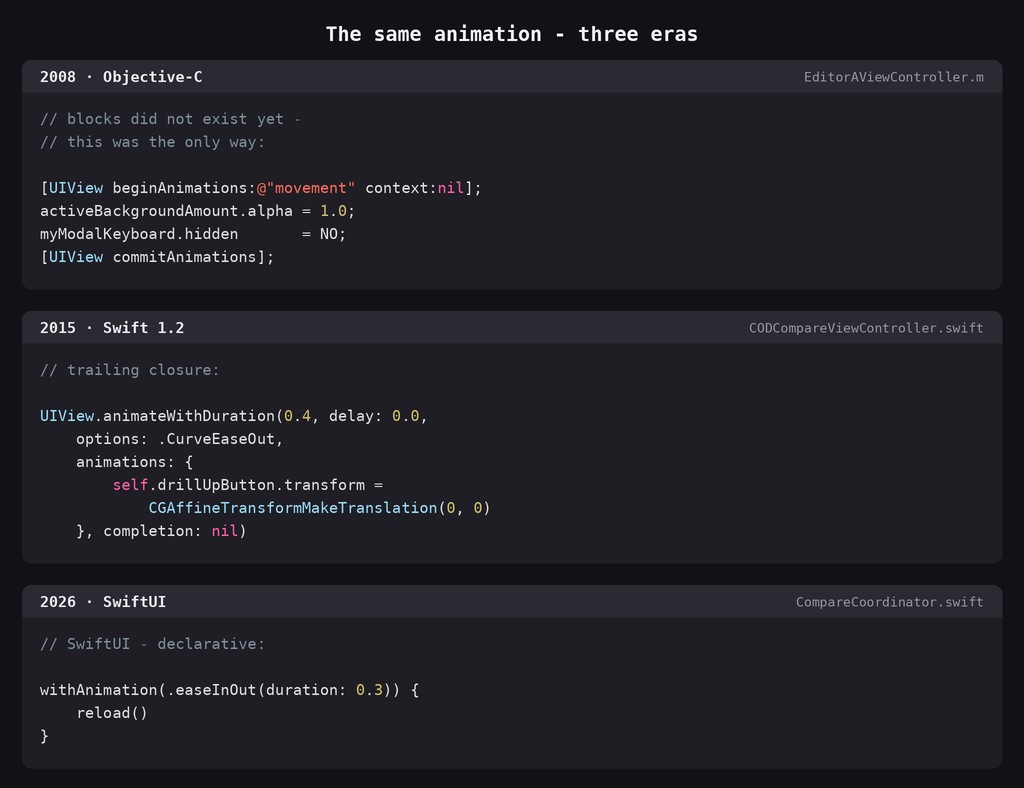
And now, another revolutionary shift. This time what changed isn't *where* I ship or *which* programming language the app is written in. This time what changed is *how* you write code at all.
My approach hasn't changed one bit: dive in deep, discover the capabilities and the limits, and prove it by building. This spring I rebuilt CompareMe from the ground up in about fifteen days — roughly 220 commits — with an AI as my partner. iOS 26. Swift 6 with strict concurrency. A complete move from UIKit to SwiftUI, and from Core Data to SwiftData. Apple's new user-interface concept Liquid Glass throughout, dark mode, accessibility — and localization in four languages, with French and Portuguese already waiting in the wings.
But the rebuild was never the point. It was the means. The clean new architecture finally made possible the one feature people had been asking me for over a decade: **save a comparison and switch between saved comparisons.** It's one of the features in CompareMe 4.0 — and it works beautifully. And yet the old core idea from 2009 stays at the center: the direct comparison of products across different pack sizes.
Along with that comes the switch to the business model that's standard for apps today: instead of the original one-time purchase — which, even with a large user base, makes maintaining and evolving the software hard — the core of the app is now free to use as a freemium app. Pro features come as a yearly subscription — free to try — or as a one-time lifetime purchase, at a founder's price for the launch.
And don't worry: I haven't forgotten the loyal customers who bought the app over the past 17 years. They get the Lifetime Pro package outright. No extra cost. That's not a marketing gesture — it's a thank-you to everyone who made CompareMe possible all these years.
The question I keep asking
Three revolutions, one idea, the same stubborn instinct each time: when the ground shifts, you don't cling to what you built — you take it into the new world and find out what's now possible.
Over the coming weeks I'll tell the whole story in pieces: how the Apple feature actually happened, what the quiet years in between taught me, and what it's really like to rebuild a seventeen-year-old app with an AI — where it felt like magic, and where it fought me every step.
CompareMe 4.0 is live now. The idea that started it all is still right there in the middle of the screen.